
The way people shop for everyday products is changing. Customers no longer always want to make a planned trip to a supermarket for milk, snacks, vegetables, beverages, toiletries, or household supplies. With quick-commerce platforms, many of these products can be ordered through a smartphone and delivered within a short period.
Quick delivery is becoming part of everyday shopping because it combines convenience, speed, product availability, and digital shopping. Here are eight major reasons behind this shift.
1. Saves Valuable Time
Time is one of the biggest reasons customers choose quick delivery. A traditional grocery trip involves travelling to a store, finding products, waiting at the checkout, and returning home.
Quick commerce removes many of these steps. Customers can search for what they need, add products to their cart, pay digitally, and continue with their work while the order is being prepared.
For busy professionals, students, parents, and households with demanding schedules, this can make routine shopping much easier.
2. Useful for Last-Minute Needs
Not every purchase can be planned in advance. A customer may suddenly run out of milk before breakfast, need snacks for guests, or discover that an important household item is missing.
Quick delivery is particularly useful in these situations.
Instead of postponing the task or making a separate trip to a store, customers can order the required item immediately.
3. Everyday Essentials Are Easy to Find
Quick-commerce platforms increasingly offer more than groceries. Customers can find products across several everyday categories.
| Category | Common Products |
|---|---|
| Groceries | Rice, flour, pulses, cooking oil |
| Fresh food | Fruits, vegetables, milk, eggs |
| Snacks | Chips, biscuits, chocolates |
| Beverages | Water, juice, soft drinks |
| Personal care | Shampoo, soap, toothpaste |
| Household | Detergent, tissues, cleaners |
| Baby care | Diapers, wipes, baby food |
| Pet care | Pet food and basic supplies |
This broader product selection means customers can use the same platform for multiple types of urgent purchases.
4. Convenience Fits Modern Lifestyles
Shopping habits have become increasingly digital. People already use smartphones for banking, entertainment, food delivery, travel, and communication.
Quick commerce extends this behaviour to everyday essentials.
A customer can order products without changing location or interrupting their routine. The convenience is particularly valuable when someone is working from home, studying, caring for children, or simply does not want to make a separate shopping trip.
5. Faster Delivery Changes Customer Expectations
Traditional online shopping often involves waiting for a scheduled delivery. Quick commerce focuses on much shorter delivery windows.
This difference changes how customers think about online shopping.
Illustrative shopping time comparison
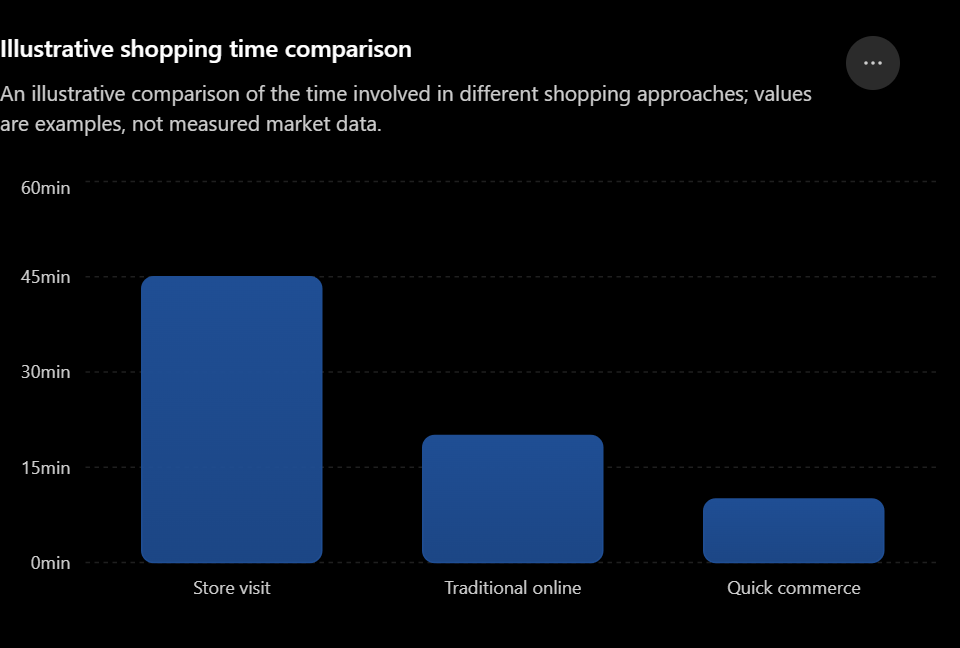
An illustrative comparison of the time involved in different shopping approaches; values are examples, not measured market data.0min15min30min45min60min
Store visit
Traditional online
Quick commerce
The chart illustrates the basic idea: the less time customers spend completing a purchase, the more attractive the shopping method can become for urgent everyday needs. Actual times vary significantly by location, store, traffic, order size, and platform.
6. Digital Shopping Makes Price Comparison Easier
Customers can usually see multiple brands and pack sizes on the same digital interface. This makes it easier to compare prices before purchasing.
For example, someone buying detergent can compare different brands, quantities, and offers without physically moving between different shelves or stores.
However, customers should also consider delivery charges, minimum-order requirements, pack size, and promotional conditions rather than looking only at the displayed discount.
7. Home Delivery Makes Heavy Purchases Easier
Some everyday products are inconvenient to carry, especially when purchased in larger quantities.
Products such as bottled water, rice, flour, detergent, cleaning supplies, and pet food can be delivered directly to the customer’s doorstep.
This reduces the physical effort involved in carrying bulky products from a store to home and can make frequent household restocking more convenient.
8. Quick Commerce Encourages On-Demand Shopping
Traditional grocery shopping often follows a fixed routine: create a list, visit a store, and purchase everything together.
Quick commerce makes another model possible—buying products when they are needed.
A customer can purchase breakfast essentials in the morning, household supplies later in the day, and snacks when guests arrive. This flexibility can be particularly useful for products that customers do not want to store in large quantities.
Quick Commerce vs Traditional Grocery Shopping
| Feature | Traditional Store | Quick Commerce |
|---|---|---|
| Shopping method | Physical visit | Mobile/online |
| Delivery | Customer carries products | Delivered to home |
| Urgent purchases | Requires a store visit | Can be ordered quickly |
| Product comparison | Physical shelves | Digital listings |
| Heavy products | Must be carried | Home delivery |
| Shopping flexibility | Store-dependent | Can order remotely |
| Planning | Often list-based | Planned or on-demand |
| Main advantage | Physical product selection | Speed and convenience |
The Growing Role of Convenience
The appeal of quick commerce is not simply about receiving products quickly. It is about reducing the amount of effort required to complete an everyday task.
Customers increasingly value shopping experiences that are simple, predictable, and convenient. Quick-commerce platforms respond to this demand by combining digital ordering, local fulfilment, inventory management, and last-mile delivery.
At the same time, speed does not automatically make every purchase better. Customers still need to compare prices, check product quantities, consider delivery charges, and avoid buying unnecessary products simply because they can arrive quickly.
Conclusion
Quick delivery is changing everyday shopping by making essential purchases more convenient and accessible. From last-minute groceries to household supplies and personal-care products, customers can increasingly order what they need without making a separate trip to a physical store.
The eight factors—time savings, last-minute convenience, product availability, lifestyle flexibility, faster delivery, easier comparison, home delivery, and on-demand purchasing—help explain why quick commerce is becoming an important part of modern retail.
As the sector continues to develop, the competition will not only be about delivering products faster. Product availability, pricing, reliability, quality, and the overall customer experience will also play an important role in shaping how people shop for everyday essentials.